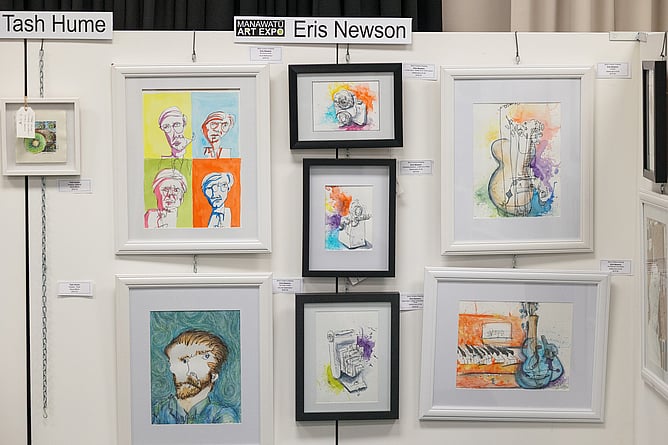
In my last blog, I explored the idea that my creative process has largely developed as a kind of language - a way of communicating with an audience. But afterwards I thought… surely that’s not always the case? Not everything I make is about communication… is it? So, in the spirit of testing myself, I decided to use blind drawing as an example to prove my own theory wrong. (How scientific of me.) As it turns out… it didn’t quite work out that way.
For me, blind drawing has largely been about taking myself out of my comfort zone and learning to be comfortable with making mistakes. It’s a way to loosen up creatively while still working within a very specific constraint: I don’t look at the page while I draw. I observe the subject - but the drawing itself is done “blind.”
That limitation changes everything.
It forces me to let go of control. I can’t correct or refine in the moment -I just have to trust the process and go with it. That said, there is still strategy involved. I tend to choose subjects with strong outlines or distinctive features, so there’s something recognisable to anchor the drawing by the end. Even within spontaneity, there’s intention.
My relationship with blind drawing actually goes back quite a long way. I can’t say when I first began experimenting with it, but in the early 2000s I had started to bring it into the classes I taught. Specifically I remember a conversation with someone about the book Drawing on the Right Side of the Brain - a book I’ve never actually read (ops fail!). They mentioned blind contour drawing as a concept, and I realised that the thing I’d been informally exploring already had a name.
The funny thing is, I’d never seen a “proper” blind drawing or been taught the technique. So I just imagined what it might be and continued experimenting in my own way. Before long, I was bringing it into the children’s art classes I taught at Square Edge in Palmerston North.
Then in 2006, during a local festival, I took it out onto the street.
I set up easels with paper and pencils and started drawing blind portraits of passersby - giving them the finished piece and encouraging them to try drawing each other. It was completely improvised. I just winged it. And it was an absolute hoot.
There was laughter, awkwardness, surprise - and moments of real connection. People were pushed out of their comfort zones, but in a way that felt safe and playful. That balance is crucial. You can’t reach the kind of mindset that allows new ideas in, without stepping outside your comfort zone - but it has to be done carefully. In a public setting especially, that’s not always easy. But with modelling, encouragement, and a bit of humour, it can happen.
And that’s a big part of what blind drawing is about.
The finished works themselves are often confronting. Some people dismiss them outright - they look like scribbles, something anyone could do. And in a way, that’s true. But that reaction is part of the work. These drawings challenge not only me as the artist but the viewer as well. They ask: what do we actually value in a piece of art?
Because blind drawing isn’t just about the outcome.
It’s about the moment it was created in. Each piece captures a single, unrepeatable experience - drawn in real time, with no correction, no second-guessing, and no safety net. The energy, the playfulness, the awkwardness, the joy - it all shows up in the line.
There’s always vulnerability in making and sharing art - but blind drawing brings that vulnerability right to the surface, especially when it’s done in public. All those familiar thoughts show up: Will this work? Is this good enough? Will they like it? Am i doing it right? But instead of trying to control them, you have to let them exist and carry on anyway.
And some of the results are, terrible.
Honestly, I have created some of the UGLIEST drawings imaginable right in front of an audience. In those moments, exposed to whatever reaction might come, you’ve really only got two choices: you can shrink and cry, or you can laugh and make something of it. More often than not, it turns into shared laughter - contagious, disarming, and unexpectedly powerful.
That laughter becomes part of the artwork.
In many ways, I’m more tuned into the audience during these pieces than in any other work I make, because I’m connecting directly with them. It’s not just about creating something to be looked at - it’s about creating a moment of connection. That connection often happens not in the finished drawing, but in the act of making it.
That’s also why I bring blind drawing into workshops. It gives people permission to let go of the outcome and simply experience the process. So many people believe they “can’t draw” because, at some point, they were taught that drawing is about accuracy, realism, or making something beautiful - before they had the skills to do so.
Blind drawing disrupts that belief.
It creates a space where you can be good enough without being “good.” Where the act of observing, responding, and engaging is what matters - not the result. And in that space, something shifts.
And so, back to that original question - does everything in my creative process act as a form of communication?
I set out to use blind drawing as the exception. Something playful, process-driven, unconcerned with outcome or audience. A way to prove that not all making needs to “say” something.
But the more I sit with it, the clearer it becomes: it still fits.
Blind drawing communicates - just not in the way we might expect. It communicates vulnerability, presence, humour, risk. It creates shared moments, invites people into the process, and challenges assumptions about what art is meant to be. Even when the result looks like chaos, there’s still a conversation happening.
So, despite my best efforts to disprove my own theory… it seems blind drawing sits right at the heart of it.